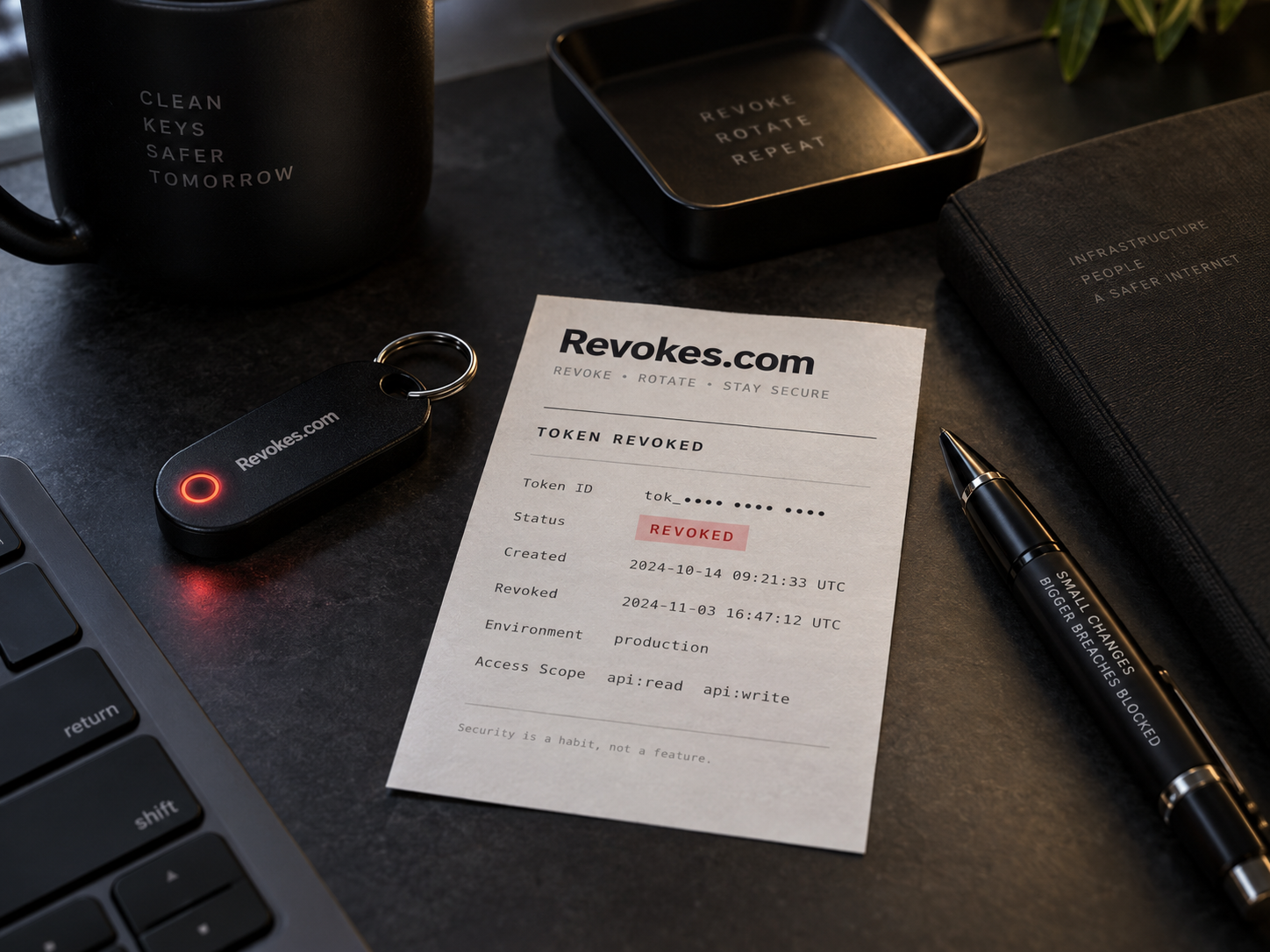
Revokes.com could be the home of a key and token management console for API product teams. The first user might be a customer administrator who needs to retire one integration credential without interrupting unrelated applications. A useful product would bring together ownership, scope, and an understandable removal action. Its value would come from helping people identify the right target and confirm the result, not from displaying secret values in a more attractive table.
Pick a control surface you can own
A focused first release could work with keys issued by one API product. That gives the team a defined issuer, permission model, and customer account structure. Supporting arbitrary credentials from many providers is a different product with a larger verification burden. Starting with one system lets the founder answer practical questions about what retirement means, who can request it, and what evidence the customer can see afterward.
The primary record could show a stable key identifier, human-readable label, owner, environment, scope, creation time, and any available usage information. Labels should help distinguish a production integration from an experiment. A display prefix can help someone recognize a credential without revealing it. The product should treat any usage timestamp according to its actual coverage, since an absent observation is not proof that no consumer still depends on the credential.
Put scope next to the action
Before retirement, the user should see the credential’s permissions and the application it is believed to serve. If the same key has been shared across workloads, the interface should make the dependency uncertainty visible. A confirmation can name the selected credential and expected effect. This is more helpful than a generic warning whose wording is identical for a test key and a production key used by several teams.
The operator also needs to understand who is allowed to make the change. A customer account owner may have different authority from an application developer. The product could provide a request path when the current user cannot retire the credential directly. That path should retain the target and reason, so the approver can review a concrete action. A permission error with no next step leaves the original problem unresolved.
Distinguish key retirement from token behavior
Keys and tokens should not inherit a single lifecycle merely because they appear in the same console. For OAuth systems, the token revocation specification describes a revocation endpoint and notes that related token behavior depends on the authorization server’s policy. A product needs to document the behavior of its own implementation. Removing one token should not be presented as a universal sign-out action.
For a proposed console, the design task is to name the object being retired and explain related effects. Does the operation prevent new credentials from being issued under the same grant? Does another credential remain available to the application? Which result can the console actually check? Those questions belong in implementation review before the customer-facing status is chosen. Precise descriptions prevent the interface from making a broader promise than the system supports.
Support routine replacement and urgent removal
A routine replacement workflow could create a new credential, let the customer update the intended consumer, and then retire the old credential after a check. The interface can track the relationship between the two versions and the owner responsible for finishing. It should be possible to see that replacement is underway without implying that the old credential has already stopped working. That unfinished state deserves a place in the main inventory.
Urgent removal has a different purpose. The user may need to stop a credential before updating its consumers. The console should make the likely affected scope visible and use the organization’s chosen authorization rules. After the action, it can guide the owner toward the remaining replacement tasks. Combining these workflows under one vague “rotate” label can hide whether the old credential was actually retired or a new one was simply created.
Make the result useful to support
A customer who reports a problem should be able to reference an operation identifier without sending a secret. The support view could show the target identifier, actor, request time, result, and observation used for confirmation. It should also show pending work and failed attempts. A record that only says “updated” leaves support staff to infer what changed. A specific operation record makes the conversation shorter and more accurate.
The console needs a plan for unavailable dependencies. If a retirement request cannot reach the issuer, it should remain pending or failed according to the actual result. Retrying must keep the same target. A customer refreshing the page should not lose the request or accidentally act on a different credential with a similar label. These mundane cases are worth testing before adding more sophisticated views of activity.
Give the first product a measurable job
An early usability exercise can ask a customer administrator to find and retire a test credential, then hand the result to a colleague. Observe whether they choose the correct environment, understand the effect, and locate the confirmation without help. Include two credentials with similar names to expose weak identification. No production secret is needed to learn whether the interface supports a careful decision.
The business opportunity under Revokes.com is a clear credential ending, supported by the context needed to perform it. A team considering the domain can describe which API product issues the credentials and who owns the removal task. That scope gives the name a useful test: does it make the product’s main job easier for the intended customer to recognize?
Ask about Revokes.com
Describe the access, identity, or entitlement product this name could become. Purchase interest and partnership proposals are welcome.
Inquire